Getting ready for a new adventure

In just over a week I’ll be starting a new job. I’ll be moving from being a reporter at the Bangor Daily News to editor of the weekly Machias Valley News Observer. In addition to editing, I will be doing quite a bit of writing.

The Bangor Daily News is an excellent newspaper. They’re very forward thinking with how they use the internet and they strive, pretty successfully, to cover the entire state of Maine. I have much respect for my colleagues there and I’m going to really miss my editor.

The thing is I believe in local news, even what could be called “hyper-local news.” You can get most national and state news anywhere. But real local news can be found only in the local paper. When it’s done right, the editor of the local paper becomes a personality within the community.

I experienced this when I lived in Pennsylvania, where I was editor of three weeklies — The Whitehall-Coplay Press, Northampton Press and Catasauqua Press. In addition to all the duties related to editing, I regularly covered a borough council meeting and wrote stories about many different subjects. I felt a strong connection to my community, especially in Whitehall-Coplay, where I had done most of my writing.

I’ve missed that.

The decision to change jobs wasn’t an easy one, however. I actually started talking to the MVNO back in January about a position that I knew would be not be available until mid to late spring. We left it at “we’ll talk again later.”

In an unrelated move in February, I began sending out queries to literary agents for my memoir. I had no idea how long it would take for me to get a positive response. I know a successful fiction writer from Pennsylvania, Kathryn Kraft, who said it took her about seven years to find an agent. I had no idea what to expect. However, by early March, I had agents asking for proposals and, in May, Maryann Karinch of The Rudy Agency, agreed to take on my project.

I knew I would soon need to make a decision on whether to move to the weekly. But was this the right time to change jobs?

I didn’t really know the answer to that, even when it came time to actually make the decision. So I just blurted out, “My gut tells me to say yes.”

My next thought was, “Oh, my god, what have I done?” I admit I was in tears when I got off the phone after giving notice to my editor at the BDN.

I noticed, however, that as the day wore on, I felt an increasing sense of relief and peace. This told me I made the right decision. And, the new job will be part time, which will give me plenty of time to work on my personal projects. I am looking forward to that.

I’m also looking forward to forging a new relationship with my community here in Maine. For the past week, I’ve been thinking a lot about the new job and I’m excited to start. That’s as it should be. Like they say, love what you do and you’ll never work a day in your life.



Town of Jonesport alive with sound of music

Music fans in Downeast Maine may have heard that last year, Livingston Taylor — James Taylor’s brother — flew in his own airplane to Jonesport to give a concert and then flew home that night.

Carole Donovan, director of the Music in the Library program at Peabody Memorial Library in Jonesport, Maine, took over the music program in the spring of 2009. She believes in asking big names to come to Jonesport, a little town along the coast of rural Maine.

“Ask and ye shall receive — or maybe not,” Donovan quipped. “Never be afraid to contact any musician about doing a concert. They may say no, but they may say yes.”

In addition to Livingston Taylor, her concert schedule has included big names such as Gordon Bok, folksinger and writer of songs of the sea; Kate Callahan, folksinger/ songwriter and 2016 Official Connecticut State Troubadour; Noel Paul Stookey, of Peter, Paul, and Mary fame; and Paul Sullivan, jazz pianist and Grammy and Tony Award winner. Many local Downeast groups have also performed as part of Donovan’s music program.

“My volunteer job is to schedule concerts under the auspices of our non-profit library,” said Donovan, who retired from teaching French at Jonesport-Beals High School. “I work over the winter contacting and scheduling musicians to come either to the library or to our larger venue, the Community of Christ Church.”

The library can seat 65, but the church, located next door, can accommodate more than 200 people.

Donovan runs the music program with the aid of “two all-important, multi-tasking sidekicks.” These are Librarian Heidi Hinkley and Kiley Hinkley, who is the library board’s youngest member. She also graduates this year from Jonesport-Beals High School as valedictorian.

Admission to most of the concerts is free. However, sometimes the library must charge admission to cover the costs of the fees charged by musicians, she said. Once the musicians’s fees are paid, 10 percent of the profit goes to the church, which hosts the bigger concerts. Any remaining money benefits the Music in the Library program.

Fundraising, unsolicited donations and ticket sales “bring in enough profit to stabilize the Music bank-account each year,” Donovan said. “Our musicians are usually understanding about the non-profit status of Peabody Memorial Library and the music program, frequently adjusting their fees to fit our ability to pay them.”

Concerts are well attended. “Less than full house is an extreme rarity,” she said.

Donovan said her volunteer position is “the most gratifying job I’ve ever had.” It’s also one of the hardest jobs she’s ever had but she said she wouldn’t trade it for anything.

The 2016 Music in the Library program kicks off at 7 p.m. June 24 with Pete Kilpatrick, who has shared the stage with The Dave Matthews Band, Barenaked Ladies, Grace Potter and the Nocturnals and many others. Ticket prices are $10 for adults and $5 for those ages 13-18. Those under age 12 get in free.

Pete
Pete Kilpatrick opens up Peabody Memorial Library’s summer music program with a concert June 24.

Kate Chadbourne will perform Irish traditional instrumentals and vocals 7 p.m. July 29. This concert is free, however a $5 per person donation is suggested.

Kate
Kate Chadbourne is the second performer lined up to play in Jonesport, Maine this summer.

Simons and Goodwin will perform soft rock, familiar tunes and original songs about Downeast Maine 7 p.m. Aug. 4. This concert also is free but a $5 per person donation is suggested.

Goodwin
Renee Goodwin and Bob Simons are set to perform at the Peabody Memorial Library in Jonesport, Maine.

Paul Sullivan, jazz pianist and winner of Grammy and Tony awards, will perform 7 p.m. Aug. 12. He will share the stage with 12-year-old Noah Carver of Beals, Maine. Noah, blind from birth, is a piano student of Paul Sullivan and is an amazing singer. Also, Laura Mazza-Dixon, on piano and strings, will perform with Paul and Noah. TIckets are $10 for adults, $5 for those ages 13-18 and free for those 12 and under.

Laura

Paul Sullivan (top left), Noah Carver (top right) and Laura Mazza-Dixon will perform Aug. 12.

For more information or to purchase tickets, call Heidi at the library at 207-497-3003 or visit www.peabody.lib.me.us.

Fun with Nicole

Fun with Nicole

Not everything that happened to Nicole and me was bad. I have a number of fond memories of my sister, who has Rett Syndrome.

As I said in my previous post, when we were kids, no one knew Nicole had Rett. What we did know was that she repeatedly clasped and unclasped her hands, a motion I called “flicking.” I later learned the hand motion is a classic characteristic of Rett Syndrome.

One day when I was about 9 or 10, my parents had a picnic and invited the whole neighborhood. I remember people everywhere outside in our yard, and a watermelon sitting on ice in a big silver tub. This watermelon tub was sitting on the ground against the side of the house near the carport. I don’t know why my parents put it there but Nicole found it.

She was sitting with her knees in front of her, her butt on her feet — we kids were so flexible back then! — and she had her right hand on the watermelon. Flick, flick, flick. I’m not quite sure how she did it but her flicking motion wore a hole in the rind of the watermelon. As a result, she had herself quite a feast.

I saw her not long after she found the watermelon but I said nothing to my parents. Later on, after she managed to dig her way into the fruit, I passed by and her eyes met mine. For a moment she looked shocked, like, “You’re not going to tell, are you?” I gave her a smile and then one burst from her face in return. Without saying a word, we had agreed to keep her mission a secret.

Later, my mother discovered Nicole’s accomplishment. Despite the fact that she had to wipe the sticky watermelon juice from my sister’s face and hands and change her clothes, she wasn’t angry. I could hear pride in her voice as she showed the neighbors what Nicole had done. If you think about it, most people couldn’t dig through a watermelon rind with one hand, so what Nicole did was pretty remarkable.

I lost my sister when my parents placed her in a nursing home for handicapped children in 1976. I saw her a few times after that, but eventually those visits stopped. I was not allowed to mention my sister’s name in my mother’s house.

When I reconnected with Nicole years later, I found someone very different from the little girl I left behind. She had grown into an adult and, in the process, the flicking stopped. She still holds her hands together but there’s no more clasping and unclasping. It may sound odd, but that is what I miss the most about the girl I knew as a child — her flicking. I guess it makes sense that I would. Flicking was a motion powerful enough to penetrate a watermelon rind!


Nicole’s sorrows

Nicole’s sorrows

What has happened to me pales in comparison to what has happened to my sister.

Nicole has Rett Syndrome, a neurodevelopmental disorder in which babies — mostly girls — may seem to develop normally but then begin to regress, losing communication skills and developing repetitive hand motions. Numerous other difficulties are also common.

My sister was born in 1966, the year an Austrian neurologist, Dr. Andreas Rett, first published his findings on Rett Syndrome. Unfortunately, nothing about Rett Syndrome was published in English language medical journals until 1983.

Throughout our childhood, Nicole’s only diagnosis was “severe and profound mental retardation.”

Nicole was 26 when I first learned about Rett Syndrome. At that time, it was said to be the leading cause of intellectual disabilities in girls. Now, it’s not certain that girls with Rett Syndrome have intellectual disabilities at all.

A girl with Rett Syndrome has an inability to use her hands or speak, making it “very difficult to make an accurate assessment of her intelligence,” says Rettsyndrome.org’s FAQ page. “Most traditional testing methods require her to use her hands and/or speech, which may be impossible for the girl with Rett.”

Wow. Think about the implications of a misdiagnosis like that. And that doesn’t even include what happened to us.

Our parents split up when I was 11 and Nicole was 9. At that time, they placed Nicole in a nursing home for handicapped children. My parents visited her at first, and even brought her to their new homes for weekends. But, gradually those visits lessened. A little more than three years after our parents split up, our father was killed by a drunk driver. Our mother then stopped visiting Nicole altogether and I got slugged if I even dared to speak my sister’s name.

I imagine our mother was dealing with feelings of guilt for not being able to care for her own child. This was before anti-discrimination laws and handicapped parking spaces and I empathize with her struggle. Even as a youth, I understood that a time would come when our mother would no longer be able to lift Nicole in and out of the bathtub.

But, my point here is to share my sister’s point of view — to the point that I can — rather than our mother’s.

I don’t remember our parents ever explaining to me why they chose to place Nicole in a nursing home. I overheard conversations between them and neighbors, so I had an inkling of what was happening and why, but no real understanding. Since our parents never explained their decision to me, it’s reasonable to assume they never explained it to Nicole, either.

So, take a look at this from Nicole’s perspective. You’re 9 years old. Suddenly and without explanation, you are sharing a room with a stranger in what looks like a hospital. You have lost your mother, your father, your sister, your dog, your cat and you home. You don’t know why and you can’t even ask anyone.

Your parents show up occasionally and you hope you will be reunited with them for good. But, each time they bring you back at the hospital and leave you there. You never know when — or if — they will come again.

I know little of my sister’s life until I turned 18, legal age. Once I reached adulthood, my mother could no longer forbid me to see my sister. (And she knew I would fight back if she tried to hit me). Though she strongly objected, I went to the nursing home where I found a mere shadow of the girl I left behind seven years earlier. Her long dark hair had been cut short. She was stiff, literally hunched over, and wearing a protective rubber helmet like wrestlers wear. Her eyes had darkened and looked empty. I held her in my arms and dissolved into tears, not even sure she knew who I was.

It was probably 15 years after our mother’s suicide in 1990 that I began to realize what Nicole had been through. By this time, Nicole had been moved to a group home. One day during a visit, a staff member and I started talking about our dad. Nicole suddenly became visibly upset. Her body was rigid, and she had her hands in her mouth. She refused to make eye contact. When the staff member or I said the word “dad,” she would scream in irritation.

My god. No one told her that our dad had died.

We explained to her what happened but she remained upset. We asked if she wanted to go to the cemetery to see his grave but she gave no indication that she did. We felt that, because of the level of discomfort she was feeling, it would be best to let it go for the time being.

Since that day, I have never asked Nicole if she wanted to see our dad’s grave. I think I was so busy with my own issues over the loss of our family that I forgot about hers.

I live in Maine now, so it’s a lot harder to get to Pittsburgh to see her than it used to be. But perhaps it’s time. Maybe she will want to see our parents’ graves. Maybe not. I should at least ask and see if I can interpret her response as a yes or a no. She deserves that much.


Happy birthday, Kira Kat

Happy birthday, Kira Kat

Shortly after midnight 17 years ago today, I heard yowling coming from my foster room.

I had been working with a cat rescue group and had a very pregnant feral cat in my care. We had trapped her intending to spay and release her. But, when we saw how far along she was in her pregnancy, we decided to let her have the kittens. We spayed and released her after the kittens were weaned.

The yowling that night told me the babies were on their way. The next morning, I went into my foster room to find five kittens — two gray, one gray and white, one black and one calico. Kira was the only longhair.

KiraKitten
Kira Kat was just 9 days old when I tool this photo. She fit in one hand.

As they grew, we saw Kira’s personality develop. She was most definitely the boss. When I put two food dishes down, Kira put her front paws inside one dish and ate, forcing all four of her siblings to share the second dish.

When the kittens were ready for adoption, we decided to keep Kira Kat. The first time she met our alpha cat, a tortie named Big Zepp, the two sniffed noses and Zepp hissed. Tiny Kira just hissed right back. Two two quickly came to an understanding and coexisted peacefully until Zepp died about two years later. Kira had always deferred to Big Zepp, even when the older cat was ailing during the last few months of her life. Once Big Zepp went to the Rainbow Bridge, however, Kira made a point to sit in all of Zepp’s favorite spots, making it clear to the other cats that she was now in charge.

All of my cats have played significant roles in my recovery from a painful past. Kira’s role was to show me what complete trust looks like. I could literally do anything with her — cradle her in my arms like a baby, wrap her around my neck like a scarf or throw her over my shoulder like a sack of potatoes — and she would remain calm and relaxed. She especially liked to be handled like a sack of potatoes and wouldn’t even hold on. Her back feet would just dangle. She trusted me not to drop her. And I didn’t.

Kira Kat was my constant companion. When I worked in my home office, I would sit my Bankie (an orange security blanket) on the desk and Kira would nap on it. She slept on my pillow and she often followed me from room to room.

inbin2
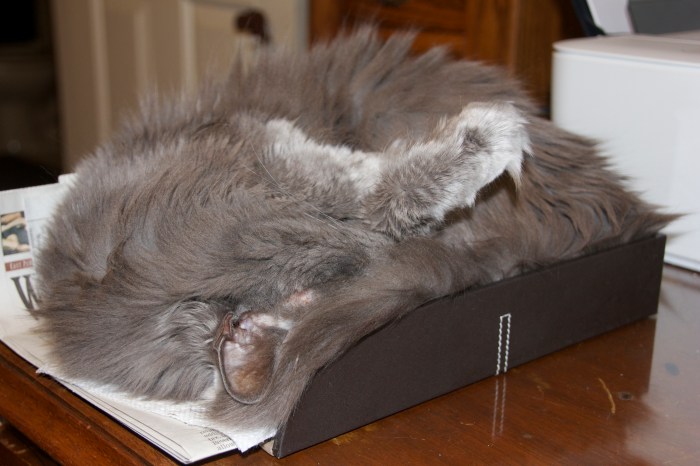
What’s in your in bin? Kira Kat liked to sleep on my desk. She decided the in bin was just for her.


We had 15 wonderful years together. Kira Kat died peacefully in our house in Pennsylvania — the same house where she was born and lived her whole life — on Jan. 26, 2015. I still miss her.

As painful as it was to lose her, I am grateful I had the chance to have such a sweet sack of potatoes in my life.

Happy birthday, Sweetie. Rest in peace.


Maine author’s book was 45 years in the making

Maine author’s book was 45 years in the making

Roma Amor wasn’t built in a day.

The 496-page novel by Jonesport, Maine, author Sherry Christie took more like 46 years.

It was finally published this month. Sherry and her supporters celebrated its arrival at a book launch party at the Peabody Memorial Library in Jonesport April 21 which, coincidentally, is Rome’s 2769th birthday.

“It took so long because originally I wrote it for myself, which meant I didn’t take much care to make it a satisfying read for others, but also because I really loved my day job as a copywriter and would end the day [or] week too mentally exhausted to work on it,” she said.

Sherry wrote and rewrote portions of Roma Amor while on writing retreats at La Muse Artists and Writers Retreat in France. She said she is grateful for her supportive husband, Harry Fish.

“I couldn’t have done it without Harry being able to give me the time to go to France without him,” she said.

Set in Caligula’s Rome around 37 A.D., the book tells the story of a young man named Marcus who wants to cast aside family expectations and live his own life.

“He’d rather go out and fight the Germans than come back and hold Caligula’s hand, which is what his father wants him to do,” she said.

Sherry writes in an office located a couple hundred feet from her house. It is staffed by two gray tabby cats, Sarge, a 15-year-old dubbed the “HR manager,” and Barney, 3, described as “the visitor” because she spends more time at home than in the office.

“We thought she was a male,” laughs Sherry, referring to Barney’s name.

Sherry has earned a living for the past 20 years as a freelance financial writer, producing items such as brochures, letters and newsletter articles for financial clients such as JPMorgan Chase, Nationwide Financial, Prudential Bank and SunTrust Banks.

She has worked with a co-author,  Washington, DC.-based psychologist Olivia Mellan, to produce five nonfiction titles related to money management. These have which have earned Sherry “a couple hundred dollars” a year since their publication.

“I was very surprised. I didn’t think anything would come of them,” she said.

Still, she is most pleased about the publication of Roma Amor. Her husband is even more excited. As of April 26, he was in the process of reading the book for the third time, she said.

Sherry said she tried to get a traditional publisher a couple of times over the years but got discouraged. She became one of the growing number of authors to self publish. As a result, she, as author, is required to take on many of the tasks that a traditional publisher would do, such as cover design, editing and getting the books into bookstores.

Sherry used the services of Machias, Maine, copyeditor Laurel Robinson to get the book ready for publication. She hired Peter O’Connor of BespokeBookCovers.com in England to deign the cover.

“I searched for design studios in Maine, but couldn’t find any with the quality cover design experience that I was looking for,” she said.

Sherry used Deborah Bailey of the Barnstormer Design Group of Jonesport, Maine, to create websites both for the book and for her financial writing business.

She is also grateful to Ruth Cash-Smith, business advisor for the Women’s Business Center at CEI in Machias, Maine. Sherry called Cash-Smith a “tremendous supporter” who has been helping with book marketing, something Sherry admits she has barely begun to do. She quipped the book launch party was “so far the highlight of my promotional career.”

While she likes being involved with all aspects of bringing her book to life, Sherry said writing is her favorite task.

“I would like to quit my day job actually and do nothing but writing books,” she said. “If I could do nothing but fiction, that would be even better.”

Amen.

Version 2
Author Sherry Christie of Jonesport, Maine
Roma Amor Front Cover
The front cover of Cherry Christie’s book, Roma Amor.

Bankie is the source of all good

Bankie is the source of all good

I found a blog today called “Visions of Johanna.” The blog is about a little girl, who shares my first name, and her family. Johanna has a brother, Teddy, whose Bankie went missing, according to a post from 2010.

When Bankie disappeared, Teddy was distraught. I could relate. I remember one childhood trip from our home in the Harrisburg area to see relatives in the Pittsburgh area, about four hours away. I’m not sure how old I was or how far we were from home when I realized my pink and red crocheted Bankie was not in the car. But I remember the fear and anguish. I immediately started bawling. Oh! Lord! How would I sleep with out it?

Somehow I managed. Apparently it wasn’t that bad because I don’t remember the rest of the trip. I was a couple years older than Teddy and I suspect my parents were trying to wean me from my Bankie.

I was about 8 when my mother finally made me a deal. If I would throw my pink and red Bankie away, my mother would give me an orange afghan she was knitting. After a series of intense negotiations, I agreed to a compromise. I would give the pink and red Bankie to the cat in exchange for the orange one. But I would not make the exchange until the orange one was completed.

I remember the day I lovingly placed my pink and red Bankie on the cat’s “throne,” a cushion on which she liked to sit. I then took the orange one and held it. It was bigger, much bigger — about the right size to cover up an adult. In contrast, the original one was small, having been made by my paternal grandmother as a baby blanket.

I slept with my head on the new orange afghan, just as I had slept on the pink and red one and I even called the new one “Bankie.”

My mother won the battle but lost the war.

She didn’t give up. When I was a teenager she would try to shame me into giving up my orange Bankie. And she would tell all my boyfriends that I would take that blanket on my honeymoon. (I did, by the way.) Nothing worked. I was determined to keep my Bankie, no matter what anyone else — including my mother — said.

My Bankie was with me when I was 15 and my father was killed by a drunk driver. My Bankie was with me when I lost my handicapped sister. My Bankie was with me when my mother died by suicide when I was 25. Bankie was, in essence, the only positive constant in what became a turbulent childhood and difficult early adulthood.

Teddy was about 16 months old when his Bankie went missing. He’s now 6, going on 7. Chances are good he has given up his Bankie by now. A part of me hopes that he hasn’t, though. Childhood end all too quickly. We grow up and find ourselves facing the responsibilities of jobs, mortgages, car payments and insurance. For me, it has certainly been worthwhile to hold on to this one special comfort item.

I’d be interested in hearing from other who still have their childhood blankets. I’ve met two or three already so I know you’re out there. Please feel free to contact me or leave a message!

Picture 3
My husband Sean and me with Bankie


Please don’t be lazy with your trash

My husband, Sean, and I have been hiking different trails both for exercise and to appreciate the special beauty of Maine and its coast. While we love the spectacular rocks, the crashing waves, the smell of the fir trees and the lovely spring weather we’ve been having, we are disheartened by how much trash we see.

Much of the trash on the beaches seems to have been washed up on shore. Little piles of unsightly trash form where the tides crest. Among these piles are a lot of lobster trap parts and buoys, though we do see the occasional water bottle or snack wrapping.

People obviously throw trash out their car windows on the roads. A lot of what we see are coffee and soda cups, though all kinds of trash litters the roadsides.

It’s embarrassing. We tell everyone how beautiful Maine is and yet we must cringe whenever we see the litter.

This issue is not unique to Maine. We saw quite a bit of litter along the roads when we lived in Pennsylvania. I suppose littering happens everywhere.

I don’t understand the littering mentality. How much effort does it take to bring your trash home and throw it away there? Many fast food restaurants will allow you to use their trash cans. And, many gas stations have trash cans situated near all the pumps, making it easy to keep the inside of your car clean without dirtying the rest of your surroundings.

The Town of Steuben is trying to do something about the litter on its roadsides. At the annual meeting in March, residents voted to spend $750 to put up signs like the one shown in the photo below and to send letters home with school children asking parents not to throw trash out the car window and to keep their property frontage clean of debris.

It’s a small investment but a commendable one. I don’t yet know how much of a difference it will make but I’m glad to know others see the need to try to curb littering. I hope this small campaign can make a difference in Steuben and then, to the surrounding areas as well. If we all throw our trash out properly, we can enhance the beauty of our community.

Happy Earth Day!


litter
This sign is posted on Pigeon Hill Road in Steuben, ME to encourage people to dispose of their trash at home rather than tossing it out the car window.


Making a difference

I’ve always wanted to make a difference. Growing up with loss — my dad was killed by a drunk driver when I was 15, my sister was placed in a nursing home when I was 11 and my mother died by suicide when I was 25 — it has always been important to me that my actions matter and accomplish some good. I suppose it’s a way for all I’ve been through to actually mean something.

I found out last week that they have. As a reporter for the Bangor Daily News covering the Down East, I recently did an article on Arise Addictions Recovery in Machias, Maine and its struggle to come up with $8,000 to pay off the building the organization purchased for its program. You can read that article here.

The following week, I ran into Paul Trovarello, Arise director, at Helen’s, a popular eatery in Machias. He thanked me for the article and said the organization had raised enough money to pay off the building in August without draining its $4,000 savings account. Thanks to the members of the community who made this possible.

I’m so pleased that the way I earn a living also makes a difference in the lives of others. My work has had a small part in helping this valuable program continue. For that opportunity, I am grateful.